Thursday, May 26, 2022

147. Chowhound

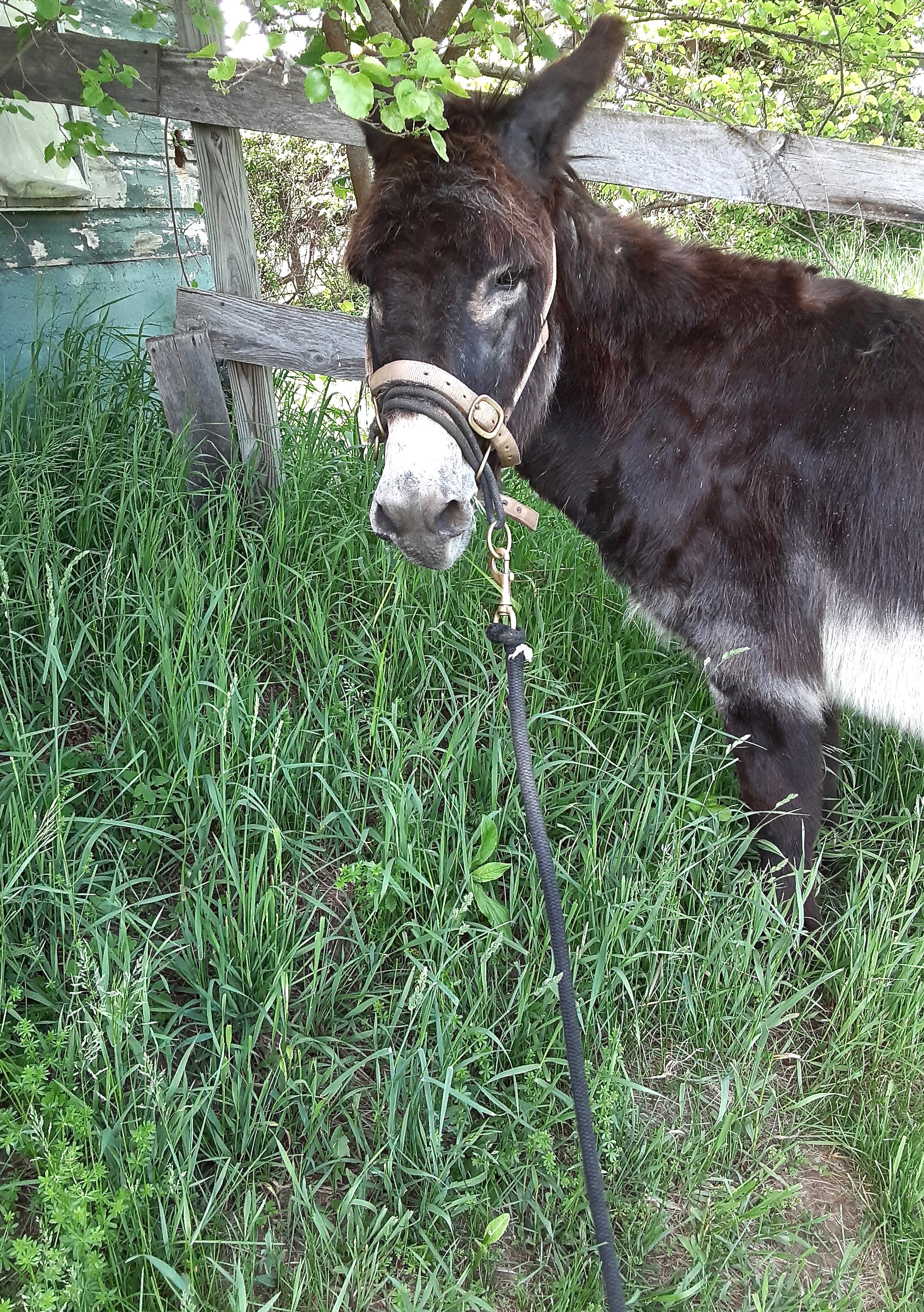
I hardly dare say this out loud, but Gus is still agreeing to end his grazing sessions pretty politely.  One reason might be that he’s discovered a swath of very lush, very tall grasses in a corner that never gets mowed, so a few minutes of gorging on that bounty seems to fill up his belly.  Once sated, he can accept the announcement of quitting time.


Today he avoids the spent dandelions, although his grazing buddy Henry the quarterhorse focuses intently on harvesting only dandelions, bundling a big sheaf of them, complete with their fluffy seedheads, into his capacious mouth.  Gus does scarf up some white-flowering chickweed that’s inextricable among the grass blades.  He and Henry both eat daintily around each neon-yellow buttercup, nudging its leaves aside as they pluck its neighbors.  


Over in the tall grass, there’s a weedy little mulberry tree with fresh new leaves and tight green flowerbuds.  Taking a momentary break from the grass, Gus reaches up and pulls a few tree leaves into his mouth.  If they cling to the branch and he can’t jerk them free, he adjusts his grip to bite down hard on the woody twig and detach it wholesale.  It gets noisily chewed up together with the leaves.  After Gus swallows maybe three mouthfuls of mulberry this way, he drops his head into the shoulder-deep grass again.


All the while, I’m improving my idle time by scrubbing my fingers over his back and sides, loosening great tufts of fur, in hopes of hurrying along his epic summertime shedding process.  As usual, he’s itchy and his skin is getting scurfy, and he’s losing fur in ugly patches.  Whether from scratching against a fencepost or tree or from clawing with a hind hoof, he’s now got a huge, raggedy-ass patch of bare skin on one side of his neck.  Rubbing his back today, I suddenly feel a mildly sickening release and come up with a dense hair-wad the size of a kaiser roll; parting the fur around the area, I find a matching expanse of pinkish skin.  


Every spring Sandy ponders how to respond to this asinine alopecia.  Topical remedies include CBD salve, diaper-rash cream, or cortisone ointment; systemic meds range from Benedryl pills to de-stung stinging-nettle leaves in his feed.  Every summer Gus finally ends up with a nice, smooth coat.  But in between, it’s an ugly and uncomfortable ordeal.  In paddock and stall, he suffers the tortures of the damned, don’t you know; out grazing, somehow he enjoys miraculous relief.


Saturday, May 7, 2022

146. Patience over anger

With an electro-stim TENS device, extra-strength acetaminophen, wintergreen and arnica and other herbal rubs, and a brilliant physical therapist, my spine and guts are recovering from the tug-of-war with Gus, the long-eared Sherman tank.

Today I bring an apple, in hopes that bribery and luring might aid my cause.  This time, I give him a good 30 minutes of gluttonous grazing before asking him to quit and come away.  Lifting his head is a bit of a haul, but when he pushes and curls and objects, I can dance away without stressing my back.  And instead of applying any pressure on the lead rope to ask him to start walking, I stand and wait.  With no fight to engage in, he seems a bit flummoxed.  He presses the top of his head into my side and leaves it there; a thin wisp of smoke curls out of both ears as he tries to rethink.  I mention the magic words “It’s time for your dinner.”  He doesn’t budge.  I use a maitre d’ gesture to usher him forward and I chirrup, “Walk on!”  Nada.  I show him the apple, which he sniffs, but then he bulls forward a few steps and rams his head back down to the turf and grabs a bite of grass.  

I lift his head again and we wait again, both of us cursing under our breaths.  I bite the apple and hold the juicy bitten piece right at his nostril, and now he eyes it and he eyes me — and he begins walking off the pasture.  We walk briskly all the way into his stall, where I toss the apple piece into his bucket and slam the door shut behind us.


Praise the Lord, a strategy may be developing.  Waiting is crucial — Gus hates feeling rushed or pressured.  Letting him make the first move is crucial — he will do nothing that isn’t his own decision to do.  And bribery with sweet treats is crucial — his natural gluttony often trumps his other agendas.


Start your clocks:  how quickly will Gus hatch some new scheme of resistance, devise an alternative escape plan, and outwit me yet again?


145. Taking the spring out of springtime

The early May grass at Gus’s farm is gorgeous.  All the equids are gobbling it up like starvelings.  For me, that presents the perennial problem of getting Gus to leave the pasture when his grazing time is up.  The horses may resist a bit when their owners pick up the lead rope and head them away from the grass, but they reluctantly assent and follow politely along.  Not Gus.  As with all things in his life, Gus does not do what he doesn’t want, and nobody can make him, so there.

Each spring, I have to remind myself how to handle — or avoid handling — this intractable problem.  With the lead rope looped both over and under his muzzle, I can prevail if it cinches tightly, and if I give it a bit of slack before he hits the end of it, and if I pull back with all my weight.  It’s not fun, but it seems preferable to letting him realize that he can pull the rope away and run off and keep grazing.

Today, I need to bring Gus into his stall  after about 20 minutes on the grass.  He shoves his anvil-like head into my ribs and pushes me away.  I dance around and evade.  He dips his head to drape the lead across his neck and starts to pull away hard.  I scurry to his other side, bringing the line off his neck again.  He backs up and backs up and backs up, until I grip the rope, at which instant he barges forward and then curls back against me.  Now I’m getting steamed and tugging on the rope, which irks him so that he resists more . . . and war is declared.  When he turns tail and revs into a fast trot straight away from me, I hang on for dear life, vituperating through gritted teeth.  He tows me across the whole pasture, my arms outstretched, my body leaned back, my knees bent to stay low, and my feet running fast to avoid being pulled down.  Not a dignified picture.


But I freakin’ win, damit!  The rope’s latch-snap digs into Gus’s chin so he finally stops running.  After that, I gather up the rope and he marches alongside me into the barn like a good soldier.  He’s smart enough to know when resistance is futile.  


Me, I’m not that smart.  Or that athletic anymore.  Within two minutes, I realize I’ve strained some crucial core muscles:  I’m not hurting, but I’m feeling jittery and woozy and almost queasy — some major abdominal nerve is panicking . . .  As I groom Gus and put away our musical toys, I begin to feel pain illuminate my lower back and wash down my right leg.  Shit!  When I suffered this same injury years earlier, from hours of digging in clay soil to haul out a buried hunk of heavy iron, the misery lasted for many months.  And here I’ve done it again just because I got mad at a donkey?  Who’s the ass now?

While I nurse my sore back, I ponder what to do when next I visit Gus.  He does need to be grazed — it’s good for his belly and brain.  But he does need to stop grazing at some point, and how can I make that happen?


Friday, May 6, 2022

144. VIDEO: Orchestrations

My friend Paul — he who so sturdily up-armored the drum and cymbals foot pedals — has furthered Gus’s musical career yet again.  I told him my aspirations for a bicycle-horn holder that could attach to the Sweet-Ass bandstand, and he devised the perfect solution. 

Onto a piece of two-by-four, he seated a firm but flexible rubber housing for the base of a CB radio antenna; into that he vertically inserted a thin fiberglas-plastic rod (such as homeowners use to mark the edges of their driveways for the winter snowplows); and at its top end, he attached a stub of PVC pipe and clamped on a new, plastic, hot-pink bulb horn that squeaks like the loudest and most obnoxious dog toy imaginable.  He even drilled a small hole through each end of the rod and used little cotter-pin devices to prevent the rod and the horn from twisting or spinning.  It’s a MacGyver of beauty.


And Gus loves it very much.  I wondered if he might at first be alarmed by the horn’s squawk being so much louder and more sudden than the old horn’s, but I shoulda known:  when he’s the one causing the noise, the brasher the better.  I still like the classic lower pitch of the old horn too, so I’m dreaming up ways to mount that one next to the new one.  And to teach Gus yet another conductor’s hand-signal to differentiate between the two . . .


[Here's one 90-second video, if you
prefer that to these staccato snippets...]


At this point in our studies, we’re pretty clear and reliable with the downward-pointing arm for stepping on the cymbals pedal and with the slow horizontal arm for playing the keyboard.  He’s still keener on stomping the pedal, so usually we start our “mi-mi-mi” warmups with him ignoring my keyboard signal and instead just pounding away on the cymbals.  But soon we get into sync, and the concerto begins to take shape.


Of course, any orchestration requires not just notes but also rests (unless it’s by Philip Glass, whose music beats any psy-ops torture at inducing abject, driveling insanity).  And no artiste can segue between “Flight of the Bumblebee” and “Sabre Dance” without risk of seizure or syncope.  Therefore, especially given Gus’s near-obsession with his music, I feel it important for his health and welfare to ensure that he take a breather now and then.  Since he’s an expert at backing up for the cha-cha and he’s an old hand at “the grownups are talking (so just stand still and be patient),” I can ask him to step away from the bandstand and then invite him back to it with a modicum of calm and control.


For directing Gus to the horn, my thumb-and-fingers squeeze gesture is still a work in progress:  I need to learn where to place my hand so that Gus can see it beyond his enormous snout, and Gus needs to learn that it’s not an invitation to nuzzle my hand for a treat.  He also needs to firm up his understanding that the bulb is the part of the horn to bite, rather than its flared bell.  The shriek of this new horn seems so gratifying to him that I’m confident he’ll learn these finer points in no time at all.


Next, watch for video of our newest instrument:  the jingle bells.


Monday, January 17, 2022

143. Winter beach toy

Today the temperature is in the teens and Gus is full of beans.  We have the (still 
well barricaded) arena to ourselves, so I let him go free and I roll a gigantic beachball past him.  He always enjoys bopping it away with the top of his nose, and he immediately chases after it.  Now he gets downright silly: he gallops at it, lowers and shakes his head like a bull, pins his ears, and bops the very bejeepers out of it. 

When I roll it back past him, he spins away, then kicks out to one side with his two hind feet, farts abruptly, and gallops off in pursuit, throwing a little buck or two as he goes.
  He barges it with chest, grunts in a menacing and satisfied manner, knees it, and then bops it.  (Donkeys fend off predators by kneeling on them and pinning them and biting them, but this ball is waist-high to a human, so it’s too big for Gus to squash the way he’d clearly like to.)  He’s so revved by this aggression-displacement game that he even pins his ears as he runs back to me for a treat.  And he gets a bit grabby, nearly nipping my hand.  Since the chase and attack is highly self-rewarding for him right now, and since I prefer to keep all ten fingers, I leave off clicking for each good bop.  He'd just as soon skip the interruptions anyway, the better to terrorize and trounce that ball.

Again and again, we gallop all over the arena, kick and fart and buck (mostly Gus, not me), and bop the ball so it damn well knows it’s been bopped.  Finally, Gus begins only trotting after it, and when he gets distracted enough to stop and stand on a mat, I figure the game is over. 

Well warmed up, we’re both ready to settle down for some slower tricks, like pedestal and pompom and, of course, music.  The cymbals, the bass drum, the horn, the keyboard — he’s refining his technique and developing his own style on all his instruments.  Stay tuned (rimshot) . . .


142. Gotta dance

With Gus feeling so good and the weather feeling so wintry, he’s still amped up each time we enter the arena and I remove his blanket.  By trial and error, though, I’ve landed on a routine that mostly obviates obstreperous, obnoxious obloquy and opprobrium (see above).

The reason Gus was yawing off in all directions and flinging his head and being a general ass is that he’s brimming with energy:  boy’s just gotta boogie and warm up.  


And the reason he refused to do so on the lunge line is that he hates the lunge whip that I brandish to get him going forward:  I must’ve used it too agressively with him in the past, and now he won’t tolerate it.  Luckily, Sandy shows me that he’s a perfectly good lunger with no whip at all.  Just by twirling the end of the long lunge rope, or even just raising my arm, I can send him around in a nice, bouncy donkeytrot.


If I lay a pole on the ground and include it in our circle, Gus happily trots over it; sometimes, he’s so up that he bounds over it as if it were two feet high.  If I want to give him a wider circle, I can just walk a circle myself — or even better, I can trot my inner circle in pace with him, which makes him practically grin.


Full disclosure:  what helps us succeed with our new lungeing protocol is a major barricade at the arena gate.  First, I not only sling the tarp over the gate, but I also line up four plastic chairs in front of it, and I post friend Barbara there.  When Gus yanks the lunge line out of my hand and rushes at the gate, she meets him with her fiercest glare and a big X of raised arms.  Seeing the tangle of chairs and the shooing of Barbara, he veers and comes back to me.  After that, I get him lungeing again (pausing for a click-and-treat the first time he passes near the gate and doesn’t consider charging it), and we end up trotting many circles in both directions with nary another glance at the exit.  The next time, I line up the chairs but do not employ a border guard, and again Gus pulls away and barges toward the door, again realizes the chairs look too troublesome to breach, and again soon forgets all about trying to break out.


At last, we have a sane and safe method for warming up and getting some good exercise when cold weather makes Gus hot to trot.


Wednesday, December 15, 2021

141. Disobedience training

Just as Gus gets rejuvenated by antibiotics (had he been harboring some other, subclinical bug for awhile, and the doxy has cured that too?), winter weather puts a nip in the air that perks up all the equids.  After a summer and fall of exemplary cooperation in the training arena, Gus 2.0 is sass on a stick:  refusing to budge, spinning away, barging, and generally blowing a big raspberry at humans one and all.

He happily enters the arena with me but immediately acts up.  I’m hurrying to unbuckle and remove his winter blanket, but he won’t stand for it — he tries to pull away and go roll.  Once he's naked and he does roll, he wants to run, run, run.  And I accommodate him, trotting alongside over ground poles and between mats and around in big circles.  When I get winded, I shove the enormous beachball for him to chase and bop with his nose.  He doesn’t just trot after it; he gallops and kicks out behind and grunts with gleeful ferocity.  He can barely contain himself.  So of course the arena can’t contain him either.  Suddenly he veers away from the beachball chase and makes for the arena gate, diving under it and scooting out of the barn at warp speed.


I follow along and find him trotting silly circles around his favorite grazing field.  The grass (its sugar content rises, I’m told, when it’s stressed by cold nights and sunny days) seems irresistible to all the horses these days.  But Gus is so jazzed that he doesn’t settle right down to grazing.  As I enter the field, just ambling and with no intention of trying to catch him, he bounces away on his short little legs, farts in my general direction, and kicks up his heels.  I join the game, clapping my hands and swirling the lead rope, which sends him cantering off like a goat on a pogo stick.  After a few circuits of the field, he does get down to grazing, and I let him.  No point in fighting that kind of energy.


Two days later, I attempt again to lead Gus in his favorite games, trotting from mat to mat, stomping the pedal of the bass drum, honking the horn, pushing the baby carriage . . .  Except for drumming, he has no patience for any of it.  He trots to one mat, tries to yaw away, consents to be led toward the next mat, and then stops dead and won't budge.  Next he pushes the baby buggy for a few feet, then bops it violently and upends it.  I barely foil an escape attempt, and I get him to cha-cha backward away from the arena gate.  He loves the cha-cha, but after several repetitions when I suggest we move to a mat, he actually rears a bit, two inches in front of me!  Then he cranks his neck and hauls me away.  

Whatever I offer him, he gives it the bum’s rush and pulls toward the exit.  I drape the gate with a tarp so his escape route under it looks blocked, but that only ratchets up his destructiveness:  he rams his chest against the gate like a linebacker, detaching its far end from the wall and knocking over nearby chairs . . .  Might as well try to keep Godzilla behind velvet theater ropes.


It’s at this juncture that, I confess, I punch him hard in the neck and call him a Very Bad Name.  He notices just enough to fling his chin high in defiance; there’s no penetrating that thick ego of his.  I collect my cool, entice him into one more set of cha-cha, and promptly effect our exit, this time with human consent and proper escort.  


As he gobbles the turf like a starveling, I use the time to recall the mayhem and despair of many a puppy kindergarten.  In these “training” classes, hapless dog owners are each orbited by an out-of-control puppy spinning on the end of the leash like a pinwheel.  The humans try to impose some modicum of order on each furry blur by means of voices and hands and treats, until they’re red-faced and casting around for a stout length of two-by-four.  Every time I’ve joined a puppy class, I’ve been convinced my dog is learning nothing and the training is useless.  But by the final session, I notice that the chaos has ebbed to a dull roar; and by the time I enroll us in adult-dog class, I realize that my youngster absorbed a lot of the puppy lessons and is fully able to learn more.

I also reminisce on the first few times I worked with Gus.  He refused to cooperate, he ran away, he broke things — and I came back the next day and simply tried the same training again.  And again.  And again.  Consistent repetition, frequent reinforcement for the right behaviors, steady expectations, unflagging persistence . . . they do eventually succeed.  

At least that’s my mantra for riding out this latest surge of asininity.  The new and improved Gus may bash me with his tidal waves, but I am a rock.  Eventually his seas will calm again.  Either that, or Sandy and I will shoot him dead and bury him in a shallow grave.


140. Under the weather

Even Gus never looked this miserable...

Gus is sick.  And he’d like you to know it.  Never a stoic, he now looks like Eeyore at his most dejected.  His walk is a slog, and his trot and canter are AWOL.  He doesn’t tug on his lead rope, or push his chest against the gate, or grab for handouts.  When I bring him into the arena, he crumples to the ground and starts a desultory roll.  Then he just lies there and naps.  I sit beside him for awhile, scritching his ears and whispering sweet nothings.  After 20 minutes, I try to get him back on his feet by luring him with treats and then brandishing a lunge whip, but all in vain.  So I call for Sandy.

She feels his joints and looks in his eyes, which all seem fine.  She takes his temperature, and even that anal insult arouses no indignation.  He has a moderate fever, a bit over 102 degrees.  We’ve seen this before:  the horse is looking great one day, and the next day it’s feverish and lethargic and off its feed.  It’s anaplasmosis, another tick-borne disease rather like Lyme.  Cool fall weather brings the ticks out in droves from the weedy thickets that edge the paddocks, and Sandy has dealt with vets and doxycycline for at least three horses in the past few months.  


Since her regular vet has essentially refused to examine or treat Gus, thanks to his near-death experience when he did try once, Sandy knows a vet visit would entail violent panic, a heavy tranquilizer administered at great risk, and all kinds of money and misery.  Instead she phones the vet, who provides good advice and an okay to use leftover doxycycline from her meds cabinet.


Sandy manages to squirt some bute — basically, horse aspirin — into Gus’s unwilling mouth, and his fever drops to normal within an hour.  I can tell his eye is brighter, and his energy is rebounding.  Then she starts him on the doxy (a powder stirred into his grain, which he eats up without demur), and within 48 hours he’s morphed into the spawn of Satan.  He now feels so much better that he’s utterly ungovernable.  Every day he yanks the lead rope out of her hands, gallops off with a snotty kick of his heels, and dodges away with a head toss when she approaches.  Sandy quips to me, behind her hand:  “I liked him better when he was a bit sick.”


Thursday, December 9, 2021

139. Donkzilla on the loose

Even the massively up-armored foot pedal, which Gus uses to beat the bass drum, already looks scuffed and battered.  Why did I harbor the least hope that the naked pedal for the hi-hat cymbals could survive his attentions?  Of course, it doesn’t.  Perhaps it was gradually weakened by a few weeks of microaggressions; anyway, one particularly emphatic stomp cracks the footplate neatly in two — the exact same break that he inflicted on the other pedal.

My doughty amateur-fabricator friend again saves the day, making a barn call to detach the pedal from the hi-hat stem and taking it home to be reinforced.  I’ll be baking him a Very Nice cake indeed . . .  Meantime, Gus and I play with the still-intact keyboard, bass drum, and bulb horn.  


I screw two rails onto his bandstand so I can slot the keyboard between them, to prevent his shoving it off the back edge and onto the arena floor.  That works fine for a few days.  But Destructo Donkey figures out that the keyboard can still slide sideways, so doesn’t he nose it right out between the rails?  He watches it hit the dirt with interest and satisfaction.  I curse him lustily.

In a pilot project to affix the horn to the bandstand, Barbara lends me a fishing-rod-like cat toy.  I use the clamp that came with the horn for attaching its barrel to a bicycle’s handlebars, though the cat-toy wand is so thin that I need to squash a thick rubber washer inside the clamp as I tighten down the screws.  This works pretty well:  the rod is flexible enough to bend as Gus bites the horn and then, when he spits it out, to bounce back upright, ready for his next grab.  


Again, though, all my ingenuity is dust in the gale-force wind of donkey determination.  The rod is slippery-smooth, and the clamp can’t clamp it hard enough: when Gus tugs at the horn he often pulls it off the rod and spits it onto the floor.  So it’s back to the drawing board for me.  Even once I locate a suitable spring or antenna or dressage whip that I can clamp the horn to, I’m sure it’ll take a few tries to install the bottom end of the wand/whip on the bandstand.  It needs to stand up enough to present the horn at donkey-mouth level, and it needs to bend and bow enough to be bitten, tugged on, and spat out repeatedly during a concert.


Am I flailing and failing?  Nope, I’m not even ankle deep in a slough of despond.  Everybody is still learning and making progress.  Gus’s urge to unseat the keyboard is an excellent opportunity for more Leave-it practice.  And holding the cat-toy wand in my hand is a great way for him to practice finding the horn with his mouth as it bobs and sways.  He’s a bit annoyed at first, but in no time he’s following it and gathering it up with his capacious lips.  He’ll have this skill down pat when we finally get the horn attached to the bandstand.  Provided he doesn’t bash said bandstand to smithereens . . .


Saturday, November 6, 2021

138. Maestro in the making

Now that Gus is mastering the keyboard, cymbals, bike horn, and bass drum in a near-simultaneous one-man orchestra, the job of conductor falls to me.  He knows verbal cues such as “play it” for the piano and “honk it” for the horn, but I stupidly adopted “stomp it” for both of his pedal-operated instruments.  Not only does “stomp it” sound very similar to “honk it” — especially amid the din of squawks and clashes — but it leaves me no way to distinguish between the bass drum and the hi-hat cymbals.  What I need is a gestural cue for each instrument.  That’ll help clarify matters for Gus, plus it’ll enhance the overall performative hilarity for any audience.

I begin by combining a well-established verbal with a brand-new gesture:  to ask Gus to run his nose along the keyboard, I say “play it” while I also sweep my arm sideways over the keyboard.  After maybe half a dozen repetitions, I switch to saying nothing as I sweep my arm, and he catches on to the gesture well enough to respond pretty reliably.  For the cymbals, I combine the usual “stomp it” with a new motion that’s a dramatic, whole-arm finger-point at the pedal.  Again, he picks up the new cue in no time.  I figure I can use a big pointing signal for the bass drum too, since that gets placed on the other side of his bandstand; in fact, I’ll use right hand for one and left for the other.

Now, what about the bike horn?  My plan is to try repeating a thumb-and-fingers squeeze motion, if for no better reason than I bet I can remember it easily, as it’s how I naturally play that horn myself.  And I expect to need every possible advantage, if I’m to be accurately pointing and sweeping in real time with Gus’s up-tempo, bebop musicality.