Showing posts with label grazing. Show all posts

Friday, December 30, 2022

156. The only good thing about snow

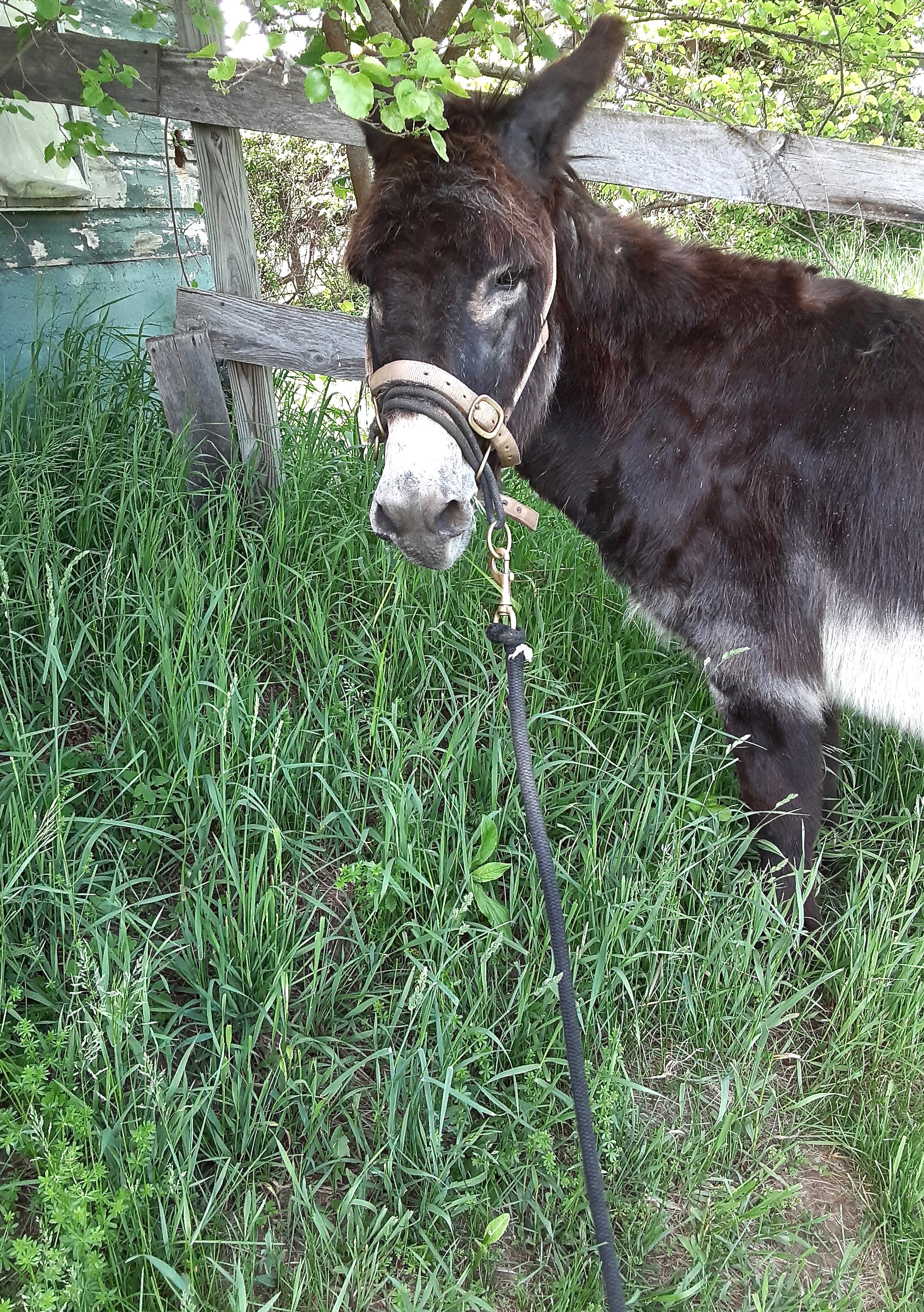
A couple of small snowfalls are enough to squash the turf, now mostly brown anyway.  The grass is evidently still yummy, but nowhere near as irresistible as it has been.  As I lead him from his paddock, Gus still sometimes hauls me over to the grazing field, but after just a few minutes of browsing the damp, half-frozen, half-dead lawn he’s totally willing to come away and into the indoor arena with me.  I never thought I’d be grateful for snow, but:  Thank-you, o, icy harbinger of darkness and death!

Once in the arena, Gus quickly recalls all its joys:  the chance to roll in the scritchy, dry dirt; games to play that bring sure and certain treats; occasionally some new learning, to really get those axons and dendrites firing.  And I’ve learned how to lunge Gus the way Sandy taught him, so now he actually enjoys running around in circles to warm up and get some exercise.  Her method is not to use a whip at all, but instead to twirl the free end of the lunge line toward his rump as the “Go!” signal.  I still line up plastic chairs in front of the arena gate, but if I lunge him in his accustomed manner, he rarely even ponders pulling away and busting through the exit.  Around and around he trots, his long ears flapping and his teacup hooves twinkling as he bounces over a couple of poles laid on the ground.  I can even ask him to canter, though the gait change is hardly noticeable, because his legs and his strides are so short.   It’s like watching a dachshund run an agility course.


Without a compulsive grass fetish to distract him, Gus is back to his mostly mannerly, often affectionate, always educable self.


Friday, October 21, 2022

155. Steamed

Today I lead Gus out of his paddock with good faith that we’ll play in the arena, including some running around to drain the excess energy that’s helping to make him an obnoxious punk rampant lately.  Not halfway to the arena, my faith is shattered.  Gus is an unreconstructed evildoer: again he drags me onto his grazing patch and won't budge.

The first couple of times this happened, I granted him his grazing rights.  I rolled with his moods and acceded to his desires.  I retained my patience, aplomb, and bonhomie.  Well, not today.  Today his snotty behavior instantly forces steam from my ears.  Even though he’s wearing a tough nylon blanket, I wallop him over the back with the tail end of the lead rope.  And I holler very bad names at him.  All of which, of course, only fuel-injects my anger and his defiance.

Before heading off to find the lunge whip, I remember to unclip his lead line for safety.  Not that he deserves any safety, I grumble to myself.  As I stalk back toward him, whip in hand, I’m grasping for any shred of positivity in this galling predicament, and I determine that I’ll still accomplish my goal of getting Gus to cover some ground and burn up energy — I’ll just do it outside rather than inside the arena.


And so the whip-waving game begins again.  Even his goat-on-a-pogo-stick canter is faster than my run, so once he leaves me in the dust, he takes a moment to stop and chomp grass, giving me a sassy side-eye as I stonily close the distance between us.  He really doesn’t care if the whip slaps his hind end, so he grabs one last mouthful before he picks up and flees just an inch before the lash might reach him.  


In a useless bid for intimidation, I smack the whip against inanimate objects that might make a loud crack.  My eye glints as I trundle past a bare picnic table, and I snap the whip down on it hard.  It gives a gratifying bang, but then I’m instantly jerked up short as the lash, caught in a knothole of the tabletop, suddenly drags me back around.  By the time I extricate the freakin’ thing, Gus is way down the path and chowing leisurely.  Dammit!  Let me tell you, it’s not easy to laugh and fume and run all at the same time.


After 20 minutes of racewalking and jogging, and dropping the whip once when I turn my ankle, and other Keystone Koppery on both our parts, I finally manage to approach Gus, hold the whip behind him as just an ushering tool, and direct his head toward his own paddock gate — which I had cunningly set ajar during one of the several times we’d racketed past it.  Clang!  Whew!  He’s corralled again, and I can go home.  Indeed you could say that my huff arrived and I left in it.


Thanks, dear reader, for allowing me to vent here.  My fury has now ebbed, all the cut-up carrot and apple bits that I never got to treat Gus with are now in a baggie, and the prospect of using them on my next visit seems almost . . . promising.  Still, just in case he frustrates me again with flaming assholery, maybe I’ll also bring a large gun. 


Thursday, May 26, 2022

147. Chowhound

I hardly dare say this out loud, but Gus is still agreeing to end his grazing sessions pretty politely.  One reason might be that he’s discovered a swath of very lush, very tall grasses in a corner that never gets mowed, so a few minutes of gorging on that bounty seems to fill up his belly.  Once sated, he can accept the announcement of quitting time.


Today he avoids the spent dandelions, although his grazing buddy Henry the quarterhorse focuses intently on harvesting only dandelions, bundling a big sheaf of them, complete with their fluffy seedheads, into his capacious mouth.  Gus does scarf up some white-flowering chickweed that’s inextricable among the grass blades.  He and Henry both eat daintily around each neon-yellow buttercup, nudging its leaves aside as they pluck its neighbors.  


Over in the tall grass, there’s a weedy little mulberry tree with fresh new leaves and tight green flowerbuds.  Taking a momentary break from the grass, Gus reaches up and pulls a few tree leaves into his mouth.  If they cling to the branch and he can’t jerk them free, he adjusts his grip to bite down hard on the woody twig and detach it wholesale.  It gets noisily chewed up together with the leaves.  After Gus swallows maybe three mouthfuls of mulberry this way, he drops his head into the shoulder-deep grass again.


All the while, I’m improving my idle time by scrubbing my fingers over his back and sides, loosening great tufts of fur, in hopes of hurrying along his epic summertime shedding process.  As usual, he’s itchy and his skin is getting scurfy, and he’s losing fur in ugly patches.  Whether from scratching against a fencepost or tree or from clawing with a hind hoof, he’s now got a huge, raggedy-ass patch of bare skin on one side of his neck.  Rubbing his back today, I suddenly feel a mildly sickening release and come up with a dense hair-wad the size of a kaiser roll; parting the fur around the area, I find a matching expanse of pinkish skin.  


Every spring Sandy ponders how to respond to this asinine alopecia.  Topical remedies include CBD salve, diaper-rash cream, or cortisone ointment; systemic meds range from Benedryl pills to de-stung stinging-nettle leaves in his feed.  Every summer Gus finally ends up with a nice, smooth coat.  But in between, it’s an ugly and uncomfortable ordeal.  In paddock and stall, he suffers the tortures of the damned, don’t you know; out grazing, somehow he enjoys miraculous relief.


Saturday, May 7, 2022

146. Patience over anger

With an electro-stim TENS device, extra-strength acetaminophen, wintergreen and arnica and other herbal rubs, and a brilliant physical therapist, my spine and guts are recovering from the tug-of-war with Gus, the long-eared Sherman tank.

Today I bring an apple, in hopes that bribery and luring might aid my cause.  This time, I give him a good 30 minutes of gluttonous grazing before asking him to quit and come away.  Lifting his head is a bit of a haul, but when he pushes and curls and objects, I can dance away without stressing my back.  And instead of applying any pressure on the lead rope to ask him to start walking, I stand and wait.  With no fight to engage in, he seems a bit flummoxed.  He presses the top of his head into my side and leaves it there; a thin wisp of smoke curls out of both ears as he tries to rethink.  I mention the magic words “It’s time for your dinner.”  He doesn’t budge.  I use a maitre d’ gesture to usher him forward and I chirrup, “Walk on!”  Nada.  I show him the apple, which he sniffs, but then he bulls forward a few steps and rams his head back down to the turf and grabs a bite of grass.  

I lift his head again and we wait again, both of us cursing under our breaths.  I bite the apple and hold the juicy bitten piece right at his nostril, and now he eyes it and he eyes me — and he begins walking off the pasture.  We walk briskly all the way into his stall, where I toss the apple piece into his bucket and slam the door shut behind us.


Praise the Lord, a strategy may be developing.  Waiting is crucial — Gus hates feeling rushed or pressured.  Letting him make the first move is crucial — he will do nothing that isn’t his own decision to do.  And bribery with sweet treats is crucial — his natural gluttony often trumps his other agendas.


Start your clocks:  how quickly will Gus hatch some new scheme of resistance, devise an alternative escape plan, and outwit me yet again?


145. Taking the spring out of springtime

The early May grass at Gus’s farm is gorgeous.  All the equids are gobbling it up like starvelings.  For me, that presents the perennial problem of getting Gus to leave the pasture when his grazing time is up.  The horses may resist a bit when their owners pick up the lead rope and head them away from the grass, but they reluctantly assent and follow politely along.  Not Gus.  As with all things in his life, Gus does not do what he doesn’t want, and nobody can make him, so there.

Each spring, I have to remind myself how to handle — or avoid handling — this intractable problem.  With the lead rope looped both over and under his muzzle, I can prevail if it cinches tightly, and if I give it a bit of slack before he hits the end of it, and if I pull back with all my weight.  It’s not fun, but it seems preferable to letting him realize that he can pull the rope away and run off and keep grazing.

Today, I need to bring Gus into his stall  after about 20 minutes on the grass.  He shoves his anvil-like head into my ribs and pushes me away.  I dance around and evade.  He dips his head to drape the lead across his neck and starts to pull away hard.  I scurry to his other side, bringing the line off his neck again.  He backs up and backs up and backs up, until I grip the rope, at which instant he barges forward and then curls back against me.  Now I’m getting steamed and tugging on the rope, which irks him so that he resists more . . . and war is declared.  When he turns tail and revs into a fast trot straight away from me, I hang on for dear life, vituperating through gritted teeth.  He tows me across the whole pasture, my arms outstretched, my body leaned back, my knees bent to stay low, and my feet running fast to avoid being pulled down.  Not a dignified picture.


But I freakin’ win, damit!  The rope’s latch-snap digs into Gus’s chin so he finally stops running.  After that, I gather up the rope and he marches alongside me into the barn like a good soldier.  He’s smart enough to know when resistance is futile.  


Me, I’m not that smart.  Or that athletic anymore.  Within two minutes, I realize I’ve strained some crucial core muscles:  I’m not hurting, but I’m feeling jittery and woozy and almost queasy — some major abdominal nerve is panicking . . .  As I groom Gus and put away our musical toys, I begin to feel pain illuminate my lower back and wash down my right leg.  Shit!  When I suffered this same injury years earlier, from hours of digging in clay soil to haul out a buried hunk of heavy iron, the misery lasted for many months.  And here I’ve done it again just because I got mad at a donkey?  Who’s the ass now?

While I nurse my sore back, I ponder what to do when next I visit Gus.  He does need to be grazed — it’s good for his belly and brain.  But he does need to stop grazing at some point, and how can I make that happen?


Saturday, October 2, 2021

131. Harvest salad

Here are a few more botanical observations derived from watching Gus graze. 

The grass is surprisingly lush and tender for this time of year, and I just learned that its sugar content rises when it gets stressed by cold nights and then has warm sunny days to recover.  So autumn grasses can be as delicious as spring growth, I guess. 


But lately Gus is widening his selections.  There’s some lance-leaved kind of plantain, still fresh and green, that he seeks out; and the clover is still good, whether it’s the yellow-blooming hop clover that grows low in the sand or the white- and red-flowered varieties that live among the grass in richer soils.  For more roughage, Gus chooses weeds that have gone by, including dried-up Queen Anne’s lace and fading bedstraw.  


He also goes for mulberry-tree leaves and even twigs, chewing them right up as if they were as tender as grass blades (though they’re much louder as his teeth grind them).  The mulberries are long gone, eaten by birds the instant they got ripe, but evidently the leaves are a toothsome treat as well.

As much as he savors his grazing, Gus has almost totally stopped digging in his heels any more when I pick his head up and walk him off the lawn.  He may yaw or lean back, but I circle him and slacken the lead line to avoid any tug-o-war, and after just one or two of these mild objections he accedes and marches obediently all the way back to his stall. I always tell him it’s nearly dinner time, and I think he must understand the word “dinner” by now.  And I never lie:  I time our return to the barn to coincide with Sandy’s feeding schedule.  Sometimes I even wait and let him watch her pull the little wagon of feed buckets across the driveway toward his barn.  I wasn’t born yesterday, and neither was he.


Saturday, March 27, 2021

119. Grazing lessons

Now that snow no longer blankets the grass around Gus’s barn, we end each arena session with some grazing time.  The grass is still 95% brown, but the tiniest filaments of green are just beginning to sprout beneath the matted old turf.  Gus has to pull back his enormous lips in order to press his teeth right down to the ground where he can nip off these earliest threads of fresh grass.  These days he’s getting about two-thirds dead grass to one-third fresh with each bite, but soon it’ll be mostly green, and then it’ll be all pure, sweet, tender, green, fresh yumminess.  For now, when he occasionally pulls up an old blade that’s too tough and tasteless, he separates it with his tongue and ejects it from the side of his mouth while still tweezing and ingesting the next bites.  Equids never forget how to graze with top efficiency.

Gus also remembers how the extra-long, extra-thick lead rope works when I hook it to the far side of his halter and thread it through the near side.  How it works is like a noose, pinching all around his snout if he tries to haul his head away from me.  The first couple of snow-free days, I had to insist on a grazing end time though he wasn’t ready.  As I made to lead him off the grass, he yawed one way, and I leaned back and held on, so he yawed and tried to trot the other way, and I leaned back and ran along and held on.  Then he recalled his lessons from last summer:  there is no escape from the cinch-rope, no matter how obnoxiously he resists it.  And today he doesn’t bother to fight at all (“resistance is futile”) but immediately walks off with me like an obedient gentleman.  In his stall, I feed him the last peppermint from my treat apron.


Saturday, August 29, 2020

108. Smokin’

Standing around while an animal grazes may have its pleasures, but it’s far from intellectually engaging.  So while Gus grazes, I make it my business to shoo away the biting flies by swinging the lead rope against his legs, gently scraping my boot along his shins, and chasing them off his belly and back.  I also make myself useful with brushless pre-grooming:  running my hands all over him to scrub off dead hair and wipe away any clinging mud or shavings or other debris.  

Today the winds are gusty.  That helps keep the flies off him, but I quickly realize it also reveals just how filthy he is.  In the past couple of days, he’s rolled repeatedly in a dust-bath wallow that he and his pasturemate Henry have excavated in their sandy-soiled paddock.   Now each time I rub Gus’s fur or pat his back, a visible puff of superfine dust erupts into the air and blows away.  I rub and pat and rub and pat, and the puffs just keep rising and blowing.  Trapped between his skin and his coat is what must be a wheelbarrowful of powdered dirt.

Absorbed in his grassy feast, Gus is oblivious, but I’m having a high old time watching the billows burst from under my hand.  I begin thumping him in syncopated rhythms, emitting complex smoke signals.  As I pat his back and neck and rump like a beatnik on bongos, he just grazes on, smoldering nonchalantly in the breeze.  Summertime, and the living is hazy.


Thursday, July 23, 2020

103. Today’s menu

As this hot, hot summer progresses, Gus’s choice of forage does too.  Along with the grass, he’s delighting in big, shaggy ragweeds lately.  White clovers, even those whose flowers are gone by, are still pretty good; plantains, now most of them gone by, are apparently much less yummy than they were a couple of weeks ago.


What never changes, for Gus as for all the horses, is that bird’s-foot trefoil is universally rejected.  A friend who recently bought a small horse farm has found that one of its pastures is at least half bird’s-foot trefoil, and both her Irish sport-horse gelding and her Morgan mare eat all around it.  I’m surprised, since trefoil is a legume, like alfalfa — horses should love it.  My friend researched it and learned that it’s perfectly edible for horses, but they tend to avoid it unless nothing else is available.


In Gus’s little patch of heaven, there’s always something else available.


Monday, July 6, 2020

101. Jawbone of an ass

When I watch Gus grazing, I get where Samson was coming from: like a heavy sword or battle axe, the jawbone of an ass really could slay a thousand men.  Gus chews like there’s no tomorrow — constantly, vigorously, powerfully.  I feel a twinge of sympathetic TMJ just thinking about the daily grind on his mandible, masseter, and molars.


As high summer diversifies the plants that are growing and flowering in our main grazing pasture, I’m once again keeping a mental log of what Gus chooses to eat.  Today he rocks my world by grabbing a big mouthful of Queen Anne’s lace, a carrot-related weed that I was surprised to see him avoid entirely last summer.  This one is over two feet tall, growing rank and dense under the fence rails.  Its stems are hard and thick and tough, but Gus’s jawbone doesn’t miss a beat, grinding up stalks, leaves, and flowers.  And going back for more.  

Then, to my even greater astonishment, he goes for a nearby chicory plant.  Last summer he took pains never to touch chicory, with its bitter radicchio flavor, but now he deliberately munches up the wiry stems, tough leaves, and blue flowers.  Wherefore, Gus?

Maybe he needs the minerals or alkaloids or vitamins in certain plants at certain times, and he knows what he smells inside each plant.  His main forage preference is always grass, but the other day included a plantain binge, while today (after the tall-weed appetizers) is all about white clover.  At one point, he stops munching and rubs his muzzle back and forth against the ground: either the flowers tickle his nose, or he’s been stung by one of the many bees working the clover patch.  


But soon he resumes chowing down.  When he wanders to some tall grasses, he tilts his head and maneuvers his very maneuverable lips to gather up a neat, long sheaf, which begins by hanging out one side of his mouth but gets shorter and shorter with each chew, as he efficiently ratchets it into his mouth and down his gullet.  Before the final bit disappears, he’s already mowing up the next serving.  Throughout any grazing session, his incisors pluck and yank a fresh mouthful even while his molars are still masticating the previous plug.  Not a moment’s rest for that awesome jawsome . . .


Monday, April 20, 2020

92. We’ll never know for sure . . .

. . . whether Gus’s relief from foot pain is due to the iodine soaks or just drier paddock footing and his own immune system.  But neither he nor Sandy nor I could give a rat's patoot: we’re just glad he’s feeling comfortable again.  

His biggest problem lately is hoovering up the lush, new grass blades as piggishly as possible whenever he gets a chance to apply his muscular muzzle to the greensward.  Tough life.


Thursday, March 19, 2020

87. Sprung

Spring has begun just enough that Gus has the fever — grass greed, reefer madness — and, with it, shocking bad manners.  Under the matted, dead, yellow, dry turf he’s found a few quarter-inch shoots of fresh green grass, and he’s adamant that nothing can come between him and them.  

Two days ago, after an excellent session of dressagey work and trick performances, I took him outside to graze, and he mashed his muzzle onto the ground to tweeze up the tiny grasslets, after 15 minutes of which, he consented to be led into his stall.  Today as I bring him out of his paddock, he eyes the ground tentatively before coming along to the arena.  Once inside, he rolls luxuriously, stands up, and immediately drags me back toward the arena gate.  For months, we’ve worked in the arena day in and day out, so it’s high time for a day off; I surprise him by opening the gate and leading him straight out for grazing.  I give him a full 30 minutes of chewy indulgence.

When I lead Gus off the grass and back into his stall, he barely demurs.  But when I latch only the top part of his stall guard and turn away just to grab a brush and hoof pick, he suddenly lowers his head, crouches, and slams under the guard.  He heads for the barn door, but Sandy and Barbara happen to be standing there talking and intercept him.  I rehalter him and suggest a return to his stall.  He’s having none of it.  He surges ahead, Sandy tries to block him head-on, and he offers to plow her down in her tracks.  She sidesteps and grabs his rope, and both of us get towed out to the driveway until, with our four hands and two body weights, we manage to stop him.  Gus at full steam is so powerful that, in his effort to wrestle free of us, he actually rears a bit.  Once I get him turned back toward the barn, I begin leading him semi-forcibly while Sandy shoos him with outstretched arms, and about halfway down the barn aisle he formally surrenders and walks into his stall.

I latch the top and bottom of his stall guard (which he realizes with a thud when he tries to reprise his ducking-under escape) before I reach for his brush.  Once contained, though, he summarily mellows out, chews hay, and welcomes affection and grooming.  You’d never know this was the same madding brute that nearly trampled two strong women just a half-minute earlier.  One deep ear-scrub later, and his bottom lip is dangling in a trance of bliss.


Friday, September 20, 2019

62. Channeling Eeyore

With the forage around the farm beginning to toughen and dry out as autumn creeps in, Gus gobbles up as much as he can while the gobbling is good.  Plantains are flowering but still emerald-leaved; grasses are yellowing at the tips but mostly still green and fresh enough; chicory and chickweed remain off the menu. 
Today Gus suprises me by grazing around the gate of a paddock where boots and hooves have trampled the ground to barren dirt.  The nearby grass is dry and powdered with dust, but Gus rips it up hungrily.  This micro-desert also hosts mats of tiny, wiry, vining weeds.  Gus works at gathering a sizable hunk between his teeth, so that a yank of his head succeeds in tearing off the whole tangled skein.  He stands in the sun, chewing and chewing until the stringy stuff is swallowed. These scrubby plants are literally “the odd bits which got trodden on” that Eeyore dolefully expects when picnicking with Pooh and crew.  In fact, Gus’s unexpected Eeyore impression is so complete that, though he has never given a thistle the time of day, now he sniffs a big thorny one before deciding to move on.

When, too late, I identify the stringy little plant as a spurge, I worry.  Spurges are notoriously toxic to humans and many animals.  They can cause vomiting, which equines are structurally unable to do — so is Gus in real danger??  I quickly recall that he ingests the occasional mouthful of oak leaves, ragweed, buttercup, and God knows what else, all with apparent immunity, so I trust his iron constitution can handle today’s garnish of spurge with the same gay abandon.  

Sure enough, he’s hale and hearty on my next visit.  Nevertheless, I do not let him graze near the patch of spurge again.


Monday, August 26, 2019

58. Botanical update

Ragweed — yum?
Oak leaves — just fine?
As summer starts to edge towared autumn, Gus’s browsing preferences seem to be changing a bit with the season.  Whereas clover never gave him a thrill in spring, now that it’s blossoming it’s a huge favorite, worth strolling around in search of.  The bedstraw is acceptable, but not the special treat it seemed to be when it was young.  To my surprise, the carrot-cousin Queen Anne’s lace is still shunned; same for chicory and burdock and ragweed — until suddenly today he yanks up a big, multistalked, green-flowering ragweed plant and systematically chews and swallows the whole thing.  Wha-a-a-a??

Gus’s first choice is always grasses, especially if the blades are long and wide and rank, as they are under the fences where the mower spares them, and in the fenny and thickety areas where they’re overfertilized by proximity to old manure piles.  He also enjoys the mower-spewed cuttings when they lie on top of the recently cut lawns.  This fodder, though, is neither fresh like live plants nor cured like hay, so I worry that it could be mouldy or fermenting or otherwise unhealthy.  But this is the animal who blithely eats oak leaves with no apparent ill effects, so I guess he can digeset old grass clippings too.

Monday, July 1, 2019

48. Better than grass

Back from my trip, I eagerly drive to the barn, where Gus commences braying before I even get out of my car.  The sun is merciless, so we immediately go to the indoor arena and do almost nothing but stroll around slowly.  When I get my footfalls into perfect sync with his, his whole body brightens a bit and his pace strengthens.  A few good strides like that, and I click and treat.  After awhile, I offer to play fetch-the-cone, but he wants to keep walking.  So we do.  When the treats are depleted and I take him out for grazing, he doesn’t barge or pull.  And when it’s time to leave the lawn, he doesn’t balk or yaw.  

Two days later, clicker guru Alexandra Kurland is on site to give lessons.  As usual, Gus is indignant at being ignored amid the comings and goings in the arena near his stall.  He bellows, drowning out our conversation.  I step away from the lesson to fill his Bubba-keg treat dispenser with hay pellets, but that doesn’t distract him for long.  Soon we hear a loud thunk and look around the corner toward his stall, in front of which we behold a tiny earthquake aftermath:  his Bubba keg has rolled into the aisle, his halter and flymask are off their hooks on the ground, and his big wooden brush box has been tipped over. 


I take him out, but he refuses to exit the barn and hauls me toward the arena.  I’m thinking, let’s eat some grass; Gus is thinking, let’s join the party.  For the first time since March or April, he’d rather not go grazing. But we can’t disrupt the horse and owner and instructor and audience absorbed in the lesson, so I quietly wrestle and cajole and insist until I finally schlep Mr. Obstreperous out the barn door and onto the grass.  Still, standing amid lush turf and succulent weeds, he leans away longingly.  Going to school with the other kids is better than Anything Else in the World.  It's heart-breaking that his only option right now is grazing and grooming, but eventually he does get into that groove of gratification.  I guide him over near the arena’s main, wide door so he can peer inside.  Just onlooking is almost good enough:  like the youngest sibling sent to bed while the big kids are partying downstairs, he’ll settle for a small saucer of popcorn and a chance to observe from the top step.

But a rain squall starts up and we have to return to the barn, with another struggle to pass the oh so alluring arena and enter his oh so cheerless stall.  As the roar of the rain on the metal roof subsides and is replaced by Gus’s bagpipe solos, Sandy leads him out to his paddock, with the same struggles past the arena entry.  Once he’s behind his gate, the intense allure of the arena as well as the decibels of his braying get slightly attenuated by distance.  Blessed relief, for him and us both.

Saturday, June 22, 2019

46. More donkey botany

For some reason, Gus is being almost polite when I bring him away from grazing.  I’d like to think he’s internalizing the new reality of his inescapable lead rope and accepting that resistance is futile.  But when he gave me some protracted hell about walking out to his paddock one recent rainy day (“I don’t do mud puddles”), I was disabused: clearly lead-line misbehavior remains his go-to form of protest.  More likely, it’s simply time that’s changed his grazing manners.  The grass is no longer so spring-fresh and intoxicatingly succulent after a barren winter.  Also I’m scheduling his grazing sessions to last 30 minutes or more and then to conclude right when Sandy is delivering evening grain.  Few things trump the chance to graze, but grain is one of them.  Gus hardly balks as I lift his head from the greensward, and he readily abandons the pasture to go to his stall when his feed bucket awaits.

Nevertheless, he’s still thoroughly committed to ingesting as much pasture as possible.  More summer wildflowers (that is, weeds) are appearing now, and I’m whiling away his hours of grazing by noting every plant he eats or shuns.  He’ll eat ground ivy, also known as gill-over-the-ground, but he steers clear of bindweed, a kind of wild morning-glory.  He eats a tall chickweed and even the fuzzy leaves, stems, and blossoms of a white-flowering campion.  He enjoys tickseed trefoil — no wonder, since it’s a legume, like alfalfa and clover.  Among humans, lamb’s quarters are favored fodder for the tree-hugging set, and violets for the more lah-di-dah set, but Gus skips both plants.  Same for betony and burdock; the low-growing, lacy-leaved pineapple weed; random potentillas, or cinquefoils; and a wild prunella known as heal-all.  But his priorities are unmistakable:  even the weeds he most enjoys, such as plantain and bedstraw, ain’t a patch on a patch of grass.  Gus, the purist in spite of himself.

Saturday, June 15, 2019

45. Botanical notes

I eat a big green salad every day.  I love, severally and individually, each item I might toss in as happenstance and the season allow.  Romaine, leaf, and head lettuces each taste of a slightly different shade of green (even when they’re red); vidalia onion is sweet and pungent; pea shoots or sunflower sprouts bring a faint whiff of good, clean dirt; red bell pepper tastes as day-glo bright as it looks; and extras — say, kalamata olives and heirloom tomatoes, or sugarsnap pea pods and chunks of apple — just make the party merrier.  No wonder I get vicarious satisfaction from Gus’s gourmet grazing.

Clockwise from top-left: bedstraw, plantain,
buttercup, chicory, clover, fescue
His multi-acre larder is now featuring a nice mix of sprouting, blooming, and fruiting plants, which his nimble lips seek avidly, take as they come, or occasionally reject.  I’ve watched him, for example, insist on cropping the bedstraw that grows under the fence rails where the mower can’t reach.  Its flower clusters, leaves, and sticky stems seem equally delicious.  Rye, fescue, blue, crab — all grasses are welcome.  Clovers large and small are fine but don’t seem a particular delicacy.  Ditto for dandelions (entirely edible even when the seedheads are fluffy) and for the wilted catkins dropped by nearby trees — they’re like peels or seeds that you don’t relish but you don’t bother to pick out either.  Buttercups are rather toxic to horses, and Gus shares his buddies’ instinctive distaste for them.  He eats around them, although if a certain mouthful does snag a stray buttercup leaf or flower, he doesn’t bother to spit it out.

(And like horses, he’s an expert spitter-outer.  If he accidentally uproots a grass rather than nipping the blade off cleanly, he continues biting fresh grass and chewing what’s in his mouth without missing a beat, but soon the roots get poked out to the side and he scissors them off and lets them drop.  No threshing machine could sort more efficiently.)

I’ve subtly steered Gus toward certain plants just to see what his mouth will think of them.  He avoids chicory and hawkweed, but he likes plantains off all shapes and sizes, blooming or not.  Not surprisingly, he also eats some sort of wild-carrot thing that grows sparsely amidst the turf, so I expect he’ll go for Queen Anne’s lace later this summer.   More botanical adventures to come, for both of us saladheads.


Monday, June 10, 2019

44. Slow comeback

Three days after the violent accident with Gus, I go to the barn to reassure him that I haven’t inexplicably disappeared from his life.  I’m still woozy and weird, so I stay outside his paddock fence and feed him chunks of apple through the bars of the gate.  He’s restless and fussy, pacing back and forth, all but shouting at me to get him the hell outta there.  But I’m too feeble to handle him safely.  I give him my regrets, scratch his neck, and leave him to his ennui and frustration.

Two days after that, I return.  It’s a hot, sunny day and I figure I can poddle around well enough to bring him into the coolth of the indoor arena for some lazy, hands-off trick-training.  When I arrive, though, he’s not stewing in his usual paddock.  Because it’s a weekend when Sandy can stay on the premises all day to round him up if he escapes, she has turned him out in the wide, multi-horse paddock with all the good grass.  Will he want to come play with me, or will he blow me off to continue grazing?

I take his halter and walk way, way out through the grass to fetch him.  I give him my signature whistle, but far from stirring him to bray and run to my arms, as he usually does —


 — today it barely elicits an ear-twitch.  At one point, he raises his head and gives me a look, but he ponders my approach, weighing its value, for only a second or two before he opts for more munching.  

Just to be sure that he's sure, I feed him a treat and slip the halter on, and I lead him toward the gate in a very clear attitude of questioning and offering, not commanding or expecting.  He kinda comes along and kinda resists, but soon he pulls enough to tell me that he wants to stay out here.  So I promptly unbuckle his halter, give him a farewell treat, and walk back.  It’s a rare privilege for him to graze in this pasture, and I’m in no condition to provide him with a training session that he’d enjoy more.

                                   ___________________________________


The next day, my noggin is feeling appreciably better.  I load my apron with the carrot and apple chunks I’d saved from yesterday, and this time the sound of my car arriving is enough to get Gus hee-hawing.  He’s back in his own boring paddock, it’s late afternoon, and he’s ready for some diversion.  I try not to be too gingerly around him (I mean, what are the chances of lightning striking twice?), but I’m relieved that he walks politely into the arena and behaves nicely in everything we do.

I take off his lead rope and we walk over a few ground rails together.  I send him to his pedestal and he pirouettes.  We walk to a wooden mat and practice standing still on it before I invite him with slow, grand arm gestures to walk around to the next mat.  He stays with me for awhile, but then the siren song of the arena dirt lures him away to inspect and sniff all over.  I reattach the lead line and he willingly rejoins our walking and mat-standing. 

I also practice asking for the backup the way clinician Alex Kurland had showed me.  I slide my hand up the lead rope to the clasp, and I turn my arm to take more control of the rope right under his halter, but I only lightly suggest a backward pressure.  And I wait.  Eventually he does start backing, and I immediately release the rope pressure.  If he stops, I ask again.  After two tries, I can keep him backing for a few paces just by “pushing” the loose belly of the rope a bit under his chin.  Much kinder and gentler than poking my finger on his shoulder and leaning my weight into his halter.

We end on this high note, and he barely tugs at all as I lead him to our usual grazing field.  I make a point of standing farther away and farther back, but nothing happens to startle him anyway.  Without meaning to (or maybe it’s a deliberate plan?), he eats his way toward the unmown grass against the doorway of the small barn, and in he walks.  He looks with interest at the first few stalls and tack trunks as we stroll down the barn aisle, but then he stops dead.  Is he just now realizing where he is?  Or does he suspect a trap?  I manage to keep him going out the far door, and only a blip of resistance darkens his brow as we head for his own barn.

He walks right into his stall and behaves like a gentleman, even when his grain arrives.  I groom the bejeepers out of him, rolling up wad after wad of loose hair.  I pick out his mud-impacted feet.  And I leave — him to his freshly bedded stall and hay tub, me to my dinner at home.

42. Ker-BLAM!

“Uh-oh . . . holy shit!” is the sound track to what briefly seems like the end of the world.  Here’s how it happens:

Gus and I shelter from the heat in the indoor arena, where we do some really quite nice long-lining, if I do say so myself.  I sometimes creep up too close behind him and let one or both reins go floppy, but I’m better at noticing it right away.  And every time I regain a gentle but steady contact on the reins, I instantly see him step out in his most businesslike way.  With that contact as our baseline, I can also take and give just a tiny bit to steer him left or right, so our zigzagging is evening out.  I remove the surcingle and reins, we do a few of our party tricks, and then we exit gladly for some grazing.  He’s now confident that I will let him graze, and I’m now confident that I will win the end-of-grazing battle to get him safely penned for the evening.  Joy and harmony embrace us.

While Gus gluts himself on grass, I stand alongside and rake my fingers through his fur, all over and repeatedly, to help him shed his winter coat.  He slips into a trance of eating and massage, two of his favorite pastimes ever.  Sandy arrives and begins her dinnertime chores, but we’re immersed in nirvana.


Next thing I know, there’s a wad of fur and bone pressing urgently into my face and chest, and I find myself stepping backward.  I only get two quick, short steps and then, in rapid succession, my feet are off the ground, I feel a slamming sensation, and my whole head is in agony.  “Uh-oh,” says a voice from afar.  The instant I realize that I’ve been knocked over backward, the next sensation I get is a hoof stepping onto my sternum and then a big movement and shadow across my body and away.  “Holy shit!” says the voice.  A second later, I feel a hand on my hand and the voice is asking me if I’m OK.

Amazingly, the wind is not knocked out of me, and I’m relatively comfortable sprawled there on the ground.  With my eyes still closed, I tell the voice, which I recognize as Sandy’s, “I think I’m actually fine.”  My first question, of course, is what the hell happened, and Sandy apologetically blames herself for not saying something before she turned on a water-hose.  Seriously??  Gus has seen and heard Sandy using a hose a thousand times before without feeling the need to spook — using the hose is no reason for her to apologize.  Dopey donkey. 


Now I realize that everything about my person that wasn’t buttoned or zippered has been sent flying by the impact.  My baseball cap has sailed way off to my side, and we finally find my glasses deposited on the turf at least three feet behind my head.  My extremities are uninjured, my retinas still in place (I had a detachment a few years ago that required major eye surgery to reattach it, so that’s always a concern for me), and my chest remarkably hoofprint-free; only my head is aching like a sonofabitch.  But I’m not queasy or dizzy or demented, so the concussion seems mild.  Sandy, always prepared, produces from her pocket two little vials of curative essential oils for me to apply to my temples and neck.  And she watches me like a mother hen to make sure I really am OK as I stand up and move around.

What about Gus, you ask?  He’s lounging a few feet away, cool as a cuke.  He’s had to relocate his grazing operation, since there’s a human selfishly spraddled across otherwise perfectly good eats, but he’s making do with the grass right nearby.  And what does he have to say for himself?  Bupkis.  The hose didn’t dance around or hiss like a snake, so what made his brain go white with panic?  All we can guess is that he was so profoundly blissed out that he lost all awareness of the world around him, and whatever he glimpsed or heard must’ve struck him as so surprising and alien that he startled like a stick of dynamite.

Already peace is upon the earth again, and Gus, thinking of dinner, hardly resists my leading him back to his stall.  I pick his feet and bid him goodnight.  On the drive home, I begin guessing which of my muscles will be sorest tomorrow.